Strategy guide · Memory Pairs
Remember the place, not the picture.
Memory Pairs is a public-information game: both players see every reveal. Give each card a stable coordinate, update the map after every turn and spend your bonus turns on pairs you already know.

Know the deck
A small, exact board
Exactly two players share a seeded 4×4 deck: 16 cards containing two copies of each of eight symbols—Sun, Moon, Star, Heart, Crown, Bolt, Flower and Gem. Flip two cards. A match stays face-up and claimed, and grants another turn.
- Mismatch is a pause, not a guess. The two cards remain visible for 900ms with input blocked, then flip down and the turn passes.
- All eight pairs end the game. The player with most pairs wins; 4–4 is a draw.
- Both players see the reveals. Track public information fairly; there is no hidden memory advantage to claim.
- Pair cards stay claimed. Remove their coordinates from your active map as soon as the match is secured.
Name the squares
Use a stable row and column
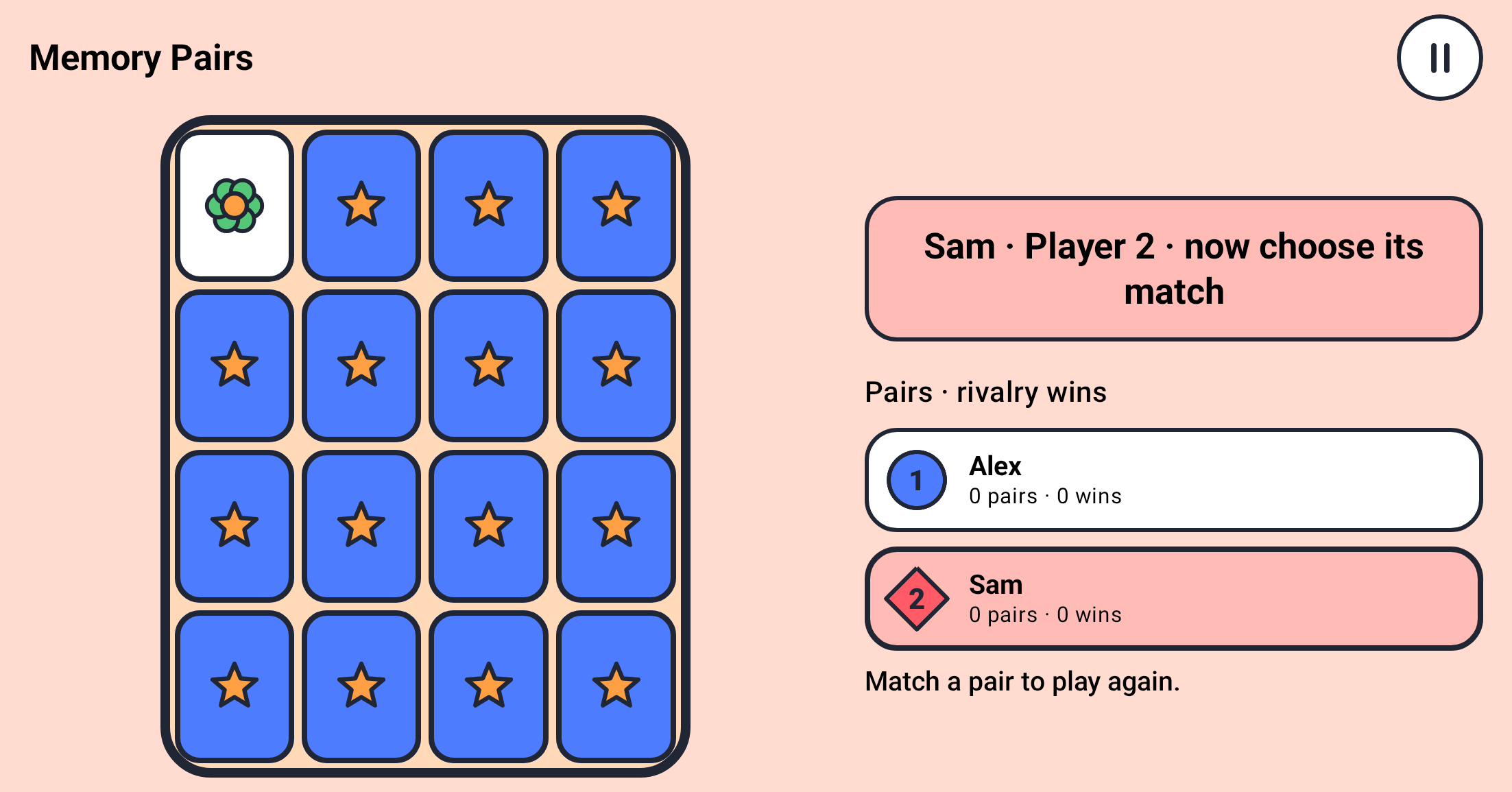
Call the top row A, then B, C and D; call columns 1 through 4 from left to right. In this capture, one Flower card is revealed at the top-left while the remaining cards are face-down; record its coordinate and wait for the matching reveal. The state labels do not depend on card colour.
Build the map
Flip for information, then cash it
After your first flip, take its known mate if you remember it. If you do not, reveal a new unknown card rather than wasting the second flip on a known non-match. A new symbol gives you a useful coordinate; a repeated known miss gives you nothing.
When you claim a pair, use the bonus turn to cash another known pair if one is available. Remove claimed coordinates from your mental map so they do not distract your next search. Watch both players’ reveals: their turn can teach you the exact card you need.
Use spatial chunks—A1–B2, then C3–D4—or a row/column rhythm. Do not rely on card colour or a vague picture impression; stable positions survive the 900ms mismatch flip.
Count the finish
Make the last pairs visible
With eight pairs total, count claimed pairs and remaining unknown cards. A 4–4 score is a draw, so one known pair can decide the result. In the endgame, a remembered mate is more valuable than a speculative flip because it converts a bonus turn into a guaranteed claim.
Keep an explicit list of every unmatched symbol and its possible coordinates. When only two unknown pairs remain, check the public reveal history before turning a fresh card; the map, not luck, tells you which second flip is useful.
Keep the flip useful
Common mistakes
- Changing coordinate names. A stable A1–D4 map is faster than remembering a picture’s colour.
- Flipping a known non-match. After the first card, choose its known mate or a genuinely unknown card.
- Ignoring the other player’s reveals. Public information belongs on your map too.
- Forgetting the bonus turn. A match stays claimed and lets you cash another known pair immediately.
- Trying to win every round. There are no memory-health claims or guaranteed wins; use the shared evidence.
Ready?
Turn every reveal into a coordinate.
There is no guaranteed win, only better bookkeeping. Name the square, watch the public information and spend every bonus turn on a pair you already know. Then try the Memory Pairs mini page on Google Play.
Play on Google Play