Strategy guide · Ludo
Make each roll matter.
Ludo rewards the token choice after the roll, not a memorised route. Balance a runner with fresh options, count what the opponent can reach in one to six, and protect the exact roll that gets a token home.
Know this ruleset
The fixed board, plainly
This is a two-player race with four tokens each on a 15×15 board. The shared route has 52 spaces running clockwise, followed by a six-position home lane for each player. A token leaves the yard onto its marked start only on a 6 and uses the full roll.
- Exact home roll. A token must roll exactly the distance to its final home space; no overshoot is legal.
- Capture on unsafe route spaces. Landing on a rival there returns that token to its yard.
- Safe spaces protect. Marked starts, home lanes and home itself cannot be captured.
- Safe starts can be occupied. If a marked start is occupied, it blocks entry or landing rather than causing a capture.
- No route stacking. Own tokens cannot share a route or unfinished home-lane position; multiple tokens may share only final home.
- One extra turn only. A legal move after a 6 or a capture grants exactly one extra turn; effects do not stack.
- No legal move passes. Even a 6 passes if no token can legally use it.
Choose after the roll
Read the one legal move
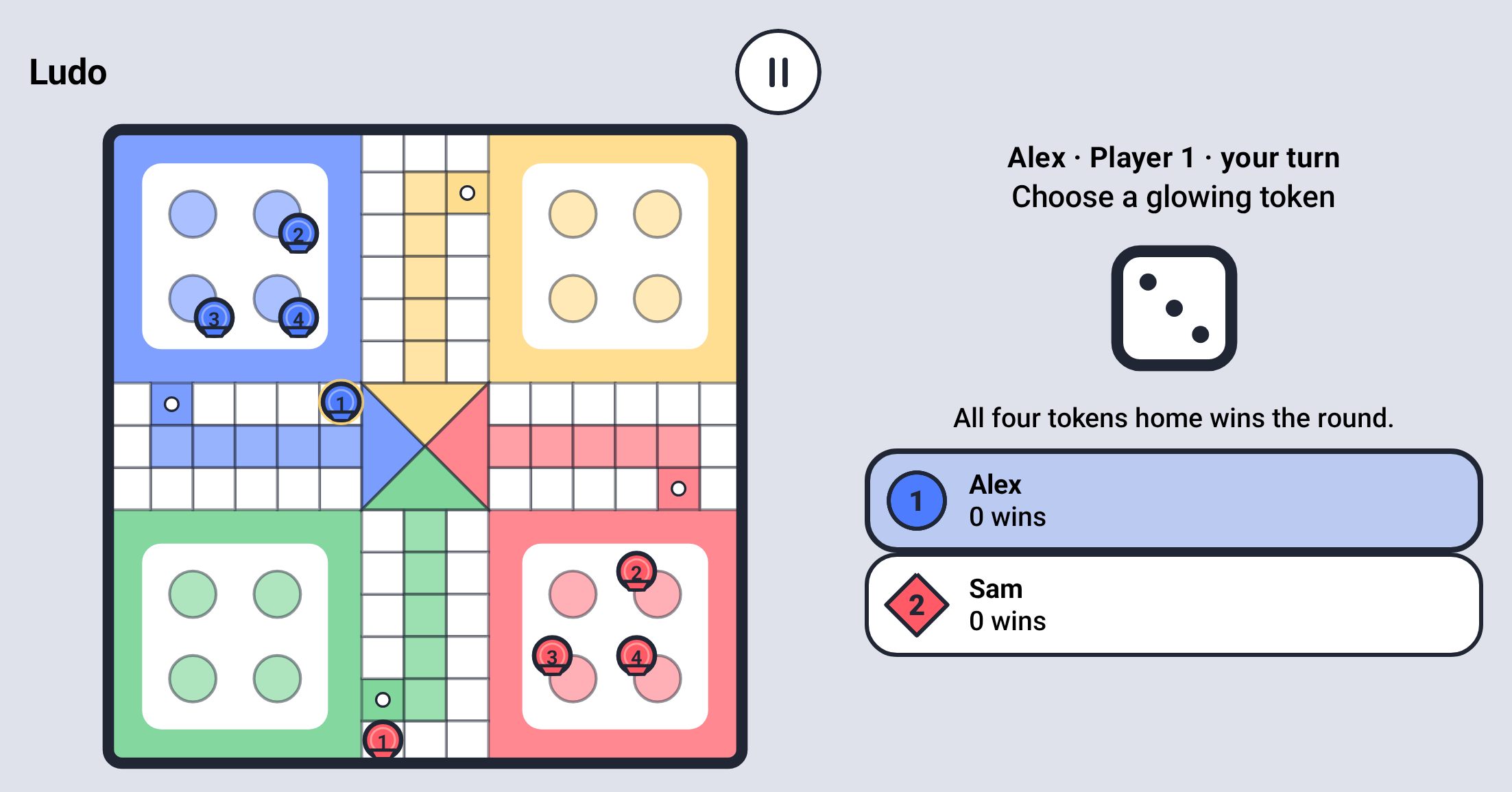
When the die shows 3, Player 1’s route token is the only legal choice; yard tokens 2–4 require a 6 to enter. Compare progress, safety and capture timing before committing.
Token priority
Win, capture, then survive
After every roll, use this order: first take an exact home move; next take a capture that is not a reckless exchange; then enter a yard token if the marked start is safe. If none applies, avoid exposing a token to the opponent’s one-to-six reach and advance or distribute your tokens.
One runner can threaten home, but four active tokens give more legal options and more chances to capture. Keep at least two moving when possible, while checking whether the opponent can reach each exposed token in one to six spaces.
Timing matters
Balance entry, capture and home
Use safe starts and home lanes as shelters. A yard entry can be strong when it gives you a fresh token that the opponent cannot immediately reach; it can be wasteful when a route capture removes a rival and earns the same single extra turn.
Plan exact-roll home moves early. A token one space from home is not finished if the die must show 1; keep a second route token moving so a miss does not strand your turn. When a capture is available, compare its reset value with the chance it leaves your own runner exposed.
The dice create uncertainty, so no opening guarantees a win. This fixed ruleset has no manual placement or blockades: play the legal choices the roll gives you.
Keep the race clear
Common mistakes
- Releasing a token automatically on 6. Check capture, safety and exact-home options first.
- Moving into a rival’s reach. Count one through six before exposing a route token.
- Assuming overshoot is allowed. A home-lane token needs the exact roll or stays put.
- Expecting bonus turns to stack. A 6 or a capture gives one extra turn, not a chain of bonuses.
- Forgetting a no-move pass. If no token can move legally, the turn passes even after a 6.
Ready?
Let the roll choose a problem, not a panic.
There is no guaranteed win in a dice race. Count reach, use safe lanes, protect exact home rolls and choose the token that leaves the best next turn. Then try the Ludo mini page on Google Play.
Play on Google Play