Strategy guide · Four in a Row
Drop with a plan, not a hunch.
Four in a Row is won by the disc you can play next, not the line you can imagine three turns away. Gravity decides which squares are real. Read the landing spaces, build two threats at once and make every drop do useful work.

Every turn
Use this gravity-first order
Scan urgent moves before choosing a set-up. “Playable” means the disc can actually land there now; an attractive hole floating above empty space is only a future idea.
- Win. Drop a disc that completes four immediately.
- Block. If the opponent has a playable winning drop, fill it first.
- Create a double threat. Make two playable winning drops for your next turn.
- Stop a double threat. Remove the opponent's only set-up square or force a block.
- Avoid supporting an enemy win. Do not fill a square that makes their winning disc playable.
- Control the centre. The centre column joins more horizontal, vertical and diagonal lines.
- Build. Improve a connected shape while keeping your next landing space flexible.
Read the landing space
Gravity changes the plan
A four-in-a-row line is useful only when the missing cell can be filled from above. A low empty cell may be playable now; a gap two rows up is unsupported until every cell beneath it is occupied. Before celebrating a threat, trace the column down to the floor.
That rule creates “support” moves. Sometimes you play a harmless-looking disc beneath your future winning square, then return to the column next turn. Sometimes the opponent can use your support to complete their own line, which is why the immediate move order matters.
Horizontal, vertical and diagonal threats all obey the same landing test. Scan the row, then check whether gravity lets a disc arrive in the exact cell you are counting.
A useful board check
Read gravity-supported landing spaces
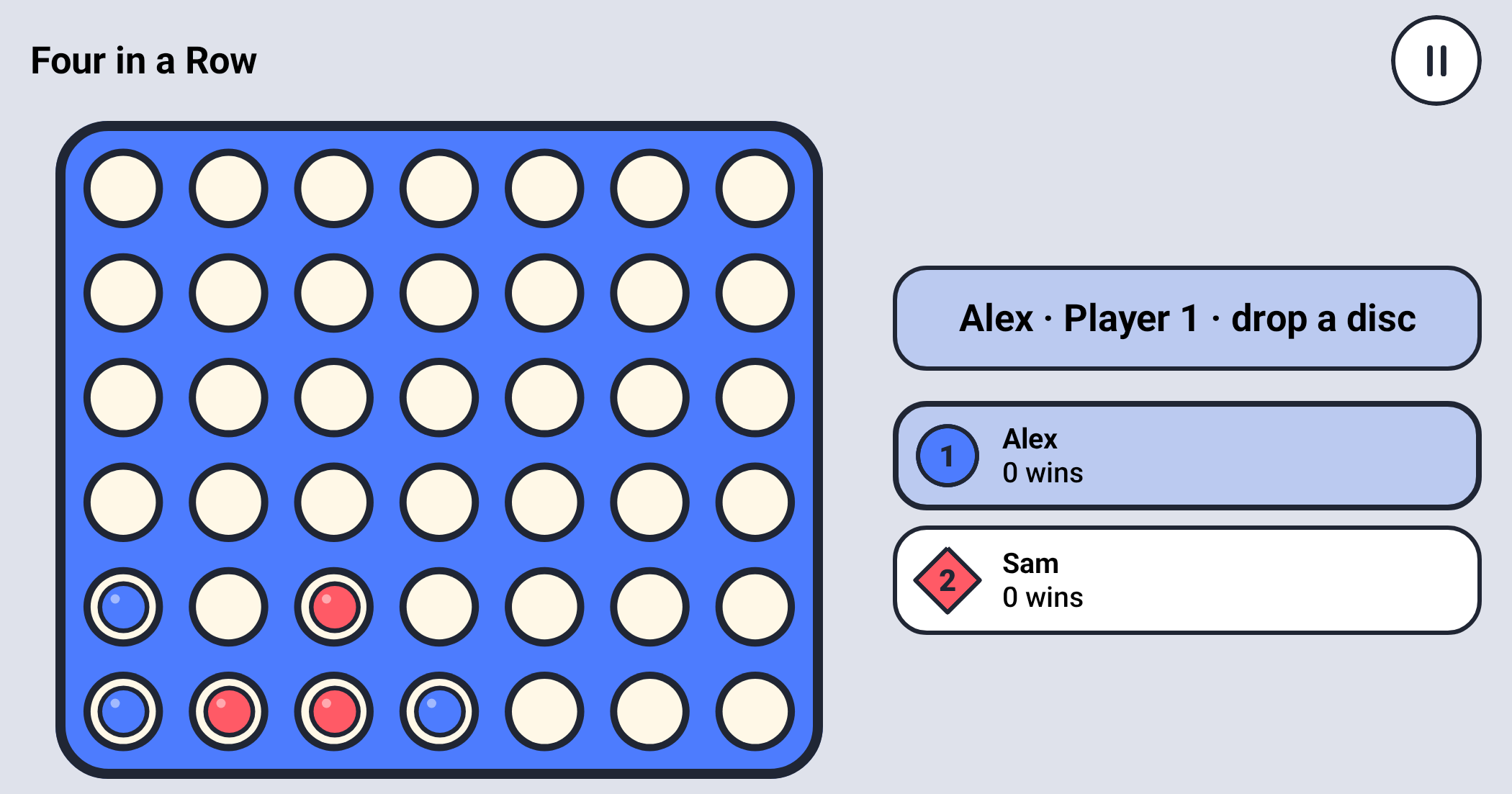
This real midgame capture is a gravity scan: count immediate wins and blocks, then verify that each candidate move has a playable landing space beneath it.
Start with shape
Openings and centre control
The centre column is the strongest first conversation because it participates in the most possible lines. Playing first, start there when it is available, then spread your next drops so you can threaten both sides. Do not treat that opening as a guaranteed win: the other player can defend accurately.
Playing second, take the centre if it is still open. If it is gone, choose a nearby column and watch which diagonal lanes your opponent has opened. Keep your discs connected, but avoid stacking a column so high that you give them an easy supported win.
Think of each opening as an invitation to create a double threat, not as a memorised sequence. The familiar alternate name Connect Four describes the goal, not a magic opening.
Keep the board honest
Common mistakes
- Counting an unsupported win. The missing square is not playable until its column is supported.
- Chasing one column. A tall stack can hand the opponent a vertical or diagonal landing.
- Ignoring the centre. Side-only play gives away too many connecting lines.
- Creating a threat that helps them. Check whether your drop supports their winning square.
- Blocking one threat and missing another. After every drop, scan horizontal, vertical and both diagonal directions.
Ready?
Make gravity your teammate.
Play a few rounds, say “playable” out loud when you spot a threat, and let the turn checklist slow down the risky drops. Then try the Four in a Row mini page on Google Play.
Play on Google Play