Strategy guide · Dots and Boxes
Count the sides, own the chain.
Dots and Boxes is not won by drawing the prettiest shape. Count the sides around every box, keep the turn when you score, and decide who controls the long chain when a sacrifice finally arrives.
Know the board
The numbers set the pace
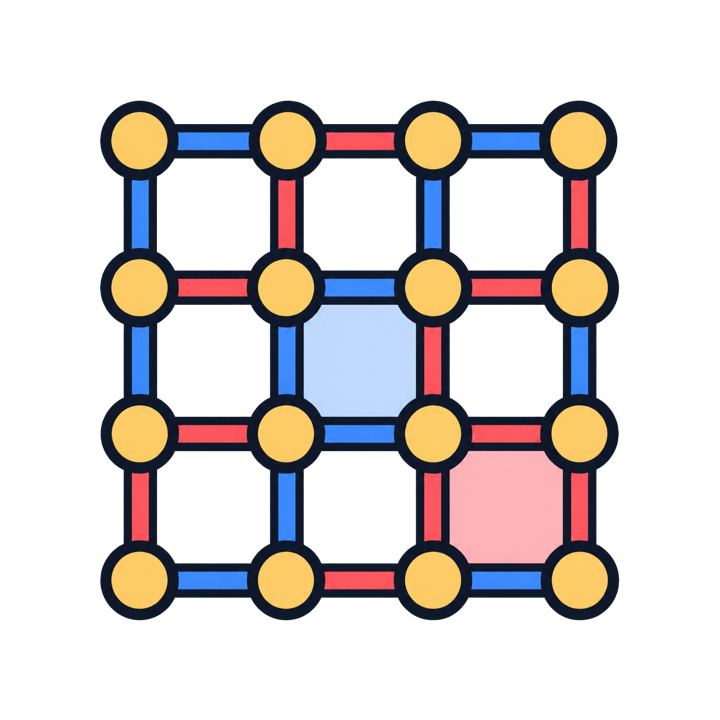
This version has exactly two players, a fixed six-row by four-column grid of 24 dots, 38 edges and 15 boxes. Complete one or two boxes to score them and keep your turn; the player with most boxes wins. Because 15 is odd, a tie is impossible.
- Count sides before every edge. Ask how many sides each neighbouring box already has.
- Take completed boxes first. If an edge closes a box, draw it and keep the turn.
- Notice a shared-edge double. One missing edge can complete two adjacent boxes at once.
- Protect the safe move. Early edges touching zero- or one-sided boxes usually give no immediate score.
The valuable exception
One shared edge can score two
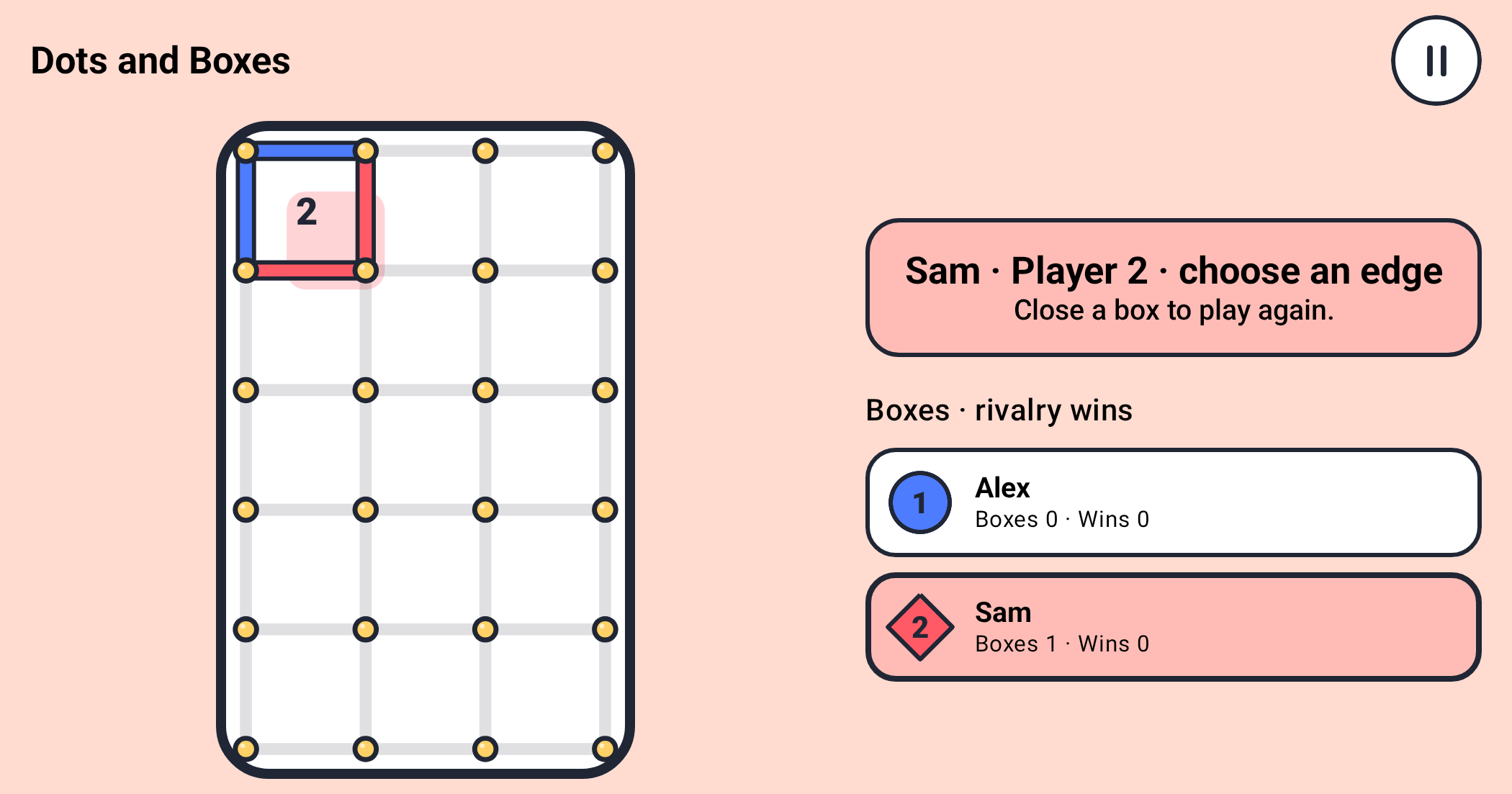
The real capture shows one claimed box and the active grid. Count the sides around each adjacent box before drawing; a shared edge may score one or two only when the board actually permits it.
Stay safe early
Zero, one, two—and never three
Early in a round, prefer an edge that touches boxes with zero or one side. Adding to a two-sided box creates the dangerous third side and is normally unsafe. The exception is when that same shared edge completes a neighbouring box, so you keep the turn and can collect the exposed box. Otherwise, a third side leaves a one-edge finish for the next player, who scores and keeps the turn.
Before drawing, count both boxes an edge touches. If either becomes three-sided, look for a different edge. When every option creates a third side, the sacrifice is unavoidable; choose where the chain begins rather than handing over the whole board.
Control the run
Sacrifice with a plan
A chain is a run of boxes that become available one after another. Once a player takes the first box, the same turn can force several more. Count the chain and the remaining boxes before you offer it; the score, not the prettiness of the line, decides whether the trade is sound.
A careful double-cross can be useful: leave the final two boxes of a long chain only when that trade keeps control of another chain. It is not an automatic trick. If giving those two boxes also hands over the next chain, decline the exchange and choose the smaller loss.
Keep a running score and a remaining-box count. With 15 boxes total, knowing whether the current chain swings the majority is more reliable than guessing from the number of edges left.
Keep the edge
Common mistakes
- Drawing without counting. The quiet-looking edge may be the third side of two boxes.
- Missing a shared double. Check both adjacent boxes before passing up a scoring edge.
- Opening the longest chain. A forced sacrifice should start with the shortest available run.
- Calling every double-cross good. Keep the final two only when you retain control elsewhere.
- Forgetting the score. Count claimed and remaining boxes; 15 means the majority is decisive.
Ready?
Make every edge answer a question.
There is no guaranteed opening. Count the sides, protect the turn, and choose chain trades with the score in view. Then try the Dots and Boxes mini page on Google Play.
Play on Google Play