Beginner guide · Chess
Learn Chess in five friendly steps.
Chess is a turn-taking puzzle for two people. Learn one small idea at a time, keep your king safe, and look for a way to trap the other king.
Step 1 · The goal
Keep your king safe
Two players share an 8×8 board. White moves first. Your goal is to trap the other king. A king under attack is in check. If there is no safe answer, it is checkmate and you win. The king is never captured, and you may not leave your own king in check.
- Check. Say “check” when the king is attacked. Its player must make a safe reply.
- Checkmate. The king is attacked and every reply is unsafe. The attacker wins.
- Legal move. A move is legal only when your own king stays safe.
Step 2 · Make a move
Tap, move, or capture
Tap one of your pieces. The game highlights its legal squares. Tap a highlighted square to move. If an opponent’s piece is there, you capture it (take it off the board). Players take turns, so pause and check what the other player could do next.
Before you move, ask: “Is my king safe?” After you move, ask: “What can my opponent capture or check?”
Step 3 · Six piece paths
Every piece has a job
Pieces cannot move through another piece. The knight is the exception: it can jump. Learn these short paths:
- King: one square in any direction.
- Queen: any distance in a straight line or diagonal.
- Rook: any distance up, down, left, or right.
- Bishop: any distance on a diagonal.
- Knight: an L shape—two squares, then one. It can jump.
- Pawn: forward one square; it captures one square diagonally.
Step 4 · Special moves
Three moves with extra rules
Castling moves the king and a rook together to help the king hide. En passant is a rare capture: if an enemy pawn moves two squares to land beside yours, capture it right away as if it moved one square. Promotion happens when a pawn reaches the far side: choose a queen, rook, bishop, or knight. The game offers these moves only when their rules allow them.
Step 5 · The finish
Checkmate or a draw?
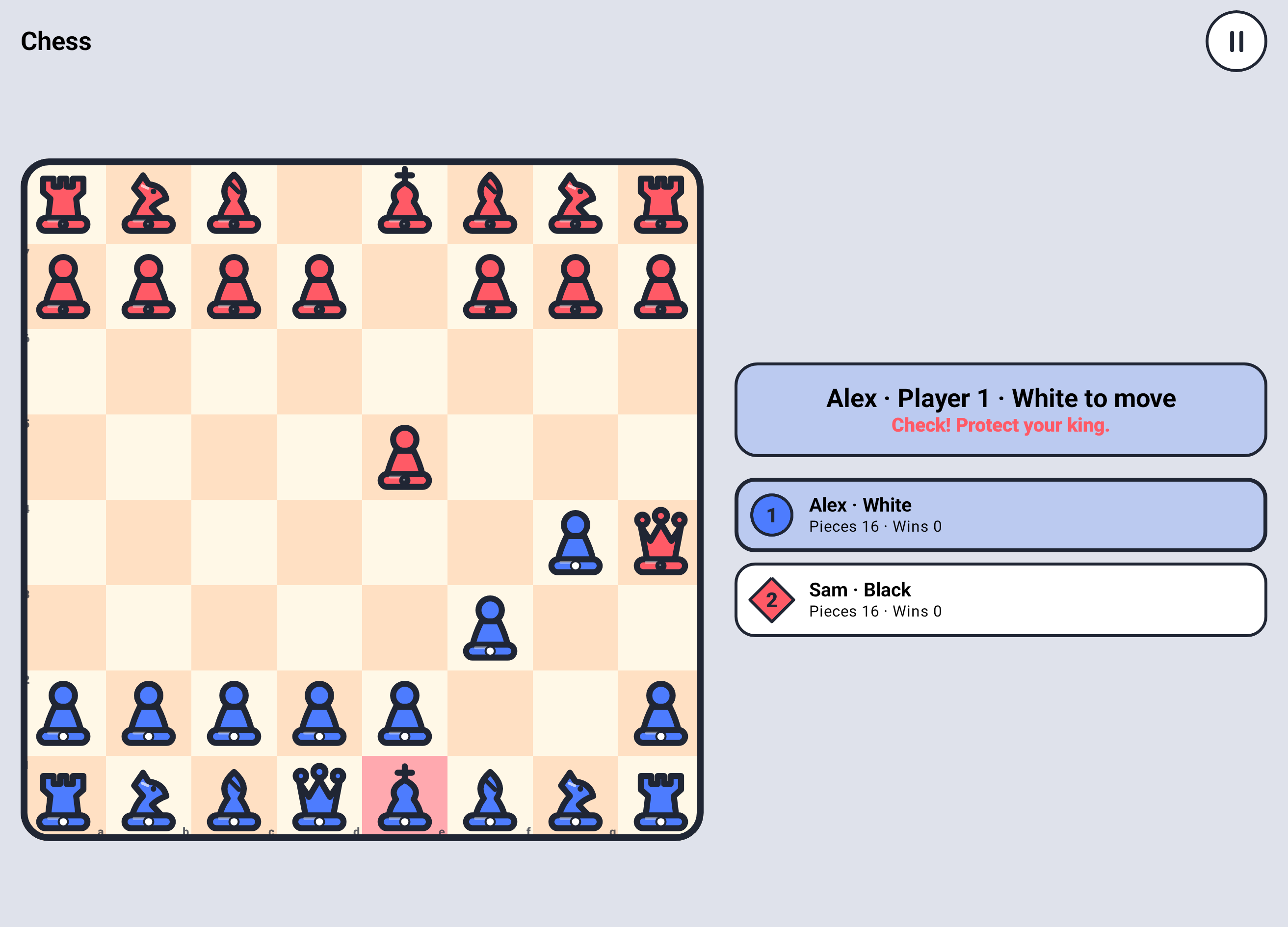
Checkmate wins. Stalemate is a draw: the king is not in check, but that player has no legal move. A game can also draw when the same position repeats, when too many quiet moves pass, or when there are too few pieces to make checkmate.
Ready?
Ready for your first puzzle?
Practice the five steps in the Chess mini page, then play the full game on Google Play.
Play on Google Play